The island of Noirmoutier: https://de.wikipedia.org/wiki/Île_de_Noirmoutier (external link)
The rowing club DNN: https://www.avironnoirmoutier.fr/page/1212868-ecole-francaise-d-aviron (external link)
The rowing
The dominant theme is the tides. By the sea, as you know, there are 2 times low tide and 2 times high tide in 24 hours. On the island of Noirmoutier, the tides are very pronounced: up to 5 m tidal stroke occur. This is much more than on the German North Sea coast.
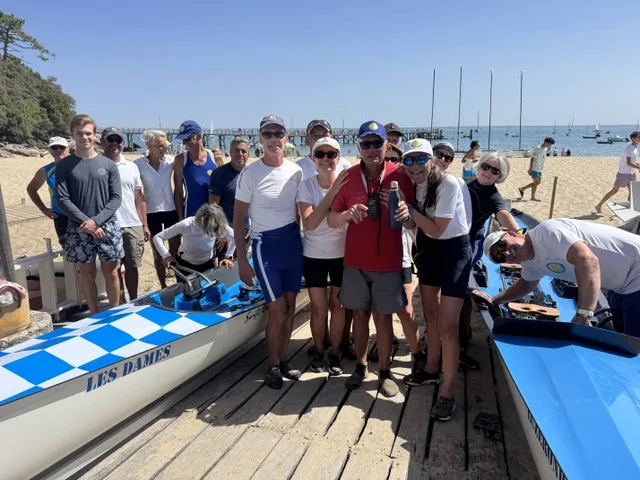
The tides mean that the boats have to be transported 20 meters and then 100 or even 200 meters to the water.
The tides mean that rowing is much more dangerous than on the lake or on rivers: There are large groups of rocks in the sea at Noirmoutier. At low tide they can be seen well, at high tide they are well below the water. But at medium altitude they are barely visible and very dangerous.
The tides lead to currents that at Noirmoutier easily have a speed of 1 to 2 km/h, in exceptional cases also up to 5 km per hour. In combination with wind and waves, this means that the route is determined by the tides – after all, you want to get back home.
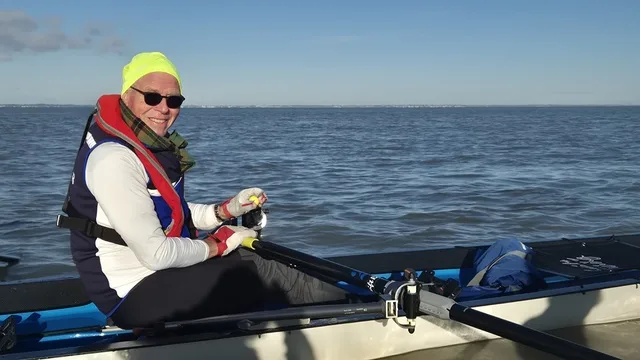
Never does a boat go to sea alone. All boats always have a VHF, i.e. a radio with which they can connect to each other and, if necessary, alert the coast guard. Life jackets mandatory. There is always visual connection. All boats have a seafaring-mounted dew with them, on which they can be towed by another boat or the coast guard if necessary. In my experience, there is a great willingness to help in rowing worldwide. But here it is particularly large - because of this permanent danger.
You always get wet- already when getting in. This is done in such a way that the boats are aligned with the bow towards the sea. But then it goes up to the legs, often up to the stomach in the water. One enters, the others hold or stabilize the boat.
On the water it can happen that the whole team sits up to the stomach in the water: when the heaviest people sit at the wheel and the lightest in the bow. And then waves come from behind: Then the helmsman has a lot to do until he empties the boat again.
The water temperatures are around 20 degrees in summer and drop to about 10 degrees in winter. Gerudert is in summer and winter!
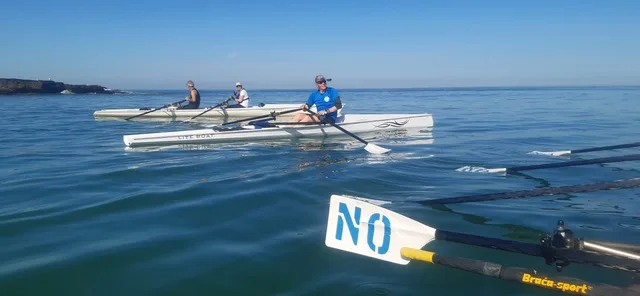
The boats are specially designed for rowing on the sea. They are wide and have large closed air chambers, so they are unsinkable and always carry. As a result, the boats are very heavy - estimated to be twice as heavy as a gig boat.
The width of the boats makes them stable. But if the waves roll properly, then you can already have the feeling in one or two that it throws the boat over. Due to the folding booms you can not stabilize with the Skulls. Then there is only the body work and it becomes a skid. With two experienced rowers, this becomes a couple dance.
Yes, this is a special feature of the boats: the booms can fold freely upwards. With the often high, short waves on the sea, this is expedient.
Cancellations due to unfavorable weather conditions occur again and again. The most common cause is the wind.
If you are lucky, you can also watch dolphins swimming next to the boats....
There are big differences between coastal rowing and rowing on lakes and regatta tracks, but in both cases, for me: After rowing, I'm always in a good mood.
The club
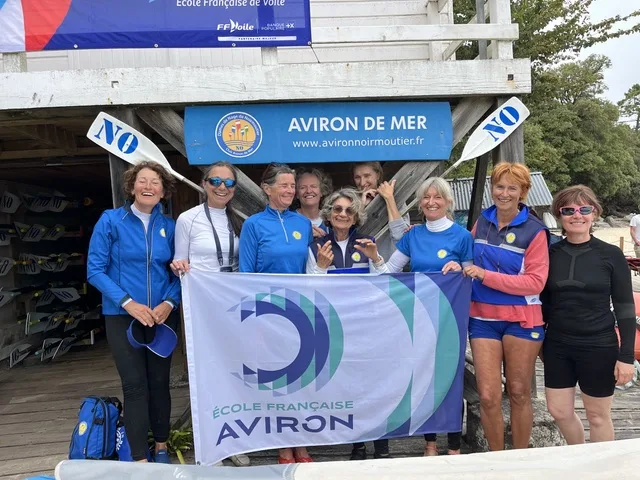
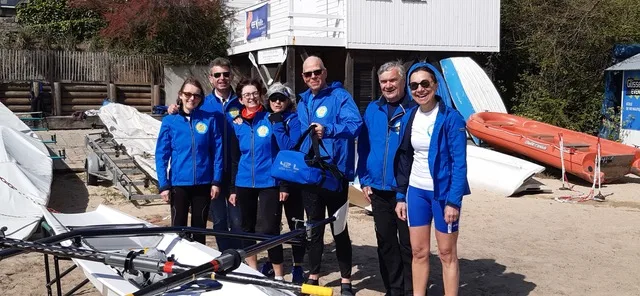
The rowing club ‘Les Dames de Nages de Noirmoutier’ DNN was founded in 2013 by residents of the island of Noirmoutier and today has around 70 members. Ladies and gentlemen about 50/50.I have been at the club since 2018. I estimate that 2/3 of the members live on the island. 1/3 rows there only on vacation. Accordingly, the presence increases in the summer months.
The name is interesting: the ‘Dames de Nages’ are the French expression for the dollen.
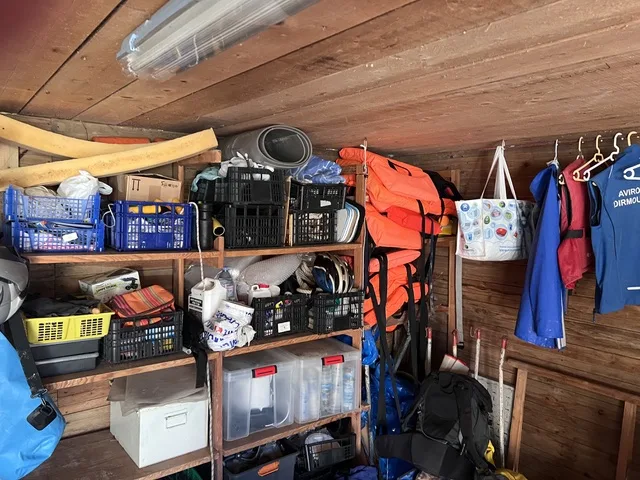
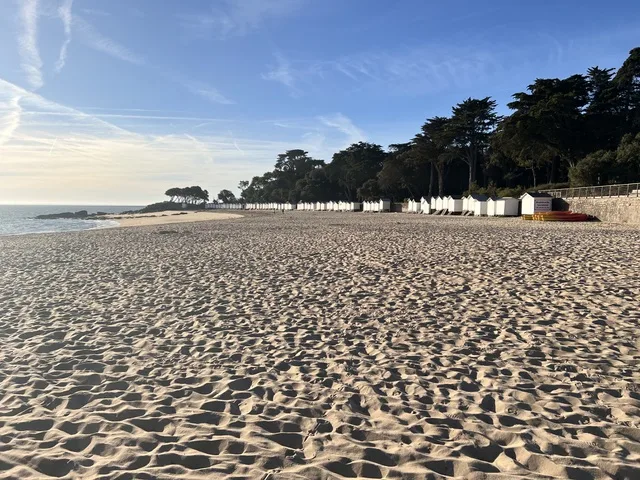
And the club is located on Plages des Dames, at the northern end of the town of Noirmoutier-en-Ile, towards the mainland. Where the shallow beach merges into a rocky coast with beautiful bays.In a shed below the sailing school on about 20 m2. Yes! on 20 square meters everything is accommodated what it needs: Skulls (mounted horizontally), rolling seats, ropes, radios, life jackets, ladles, emergency rockets, etc. Everything is organized very efficiently, e.g. the writing board, which is filled in before each exit: with the ‘Responsable du Sortie’ (the person responsible for the exit), the boats, the crews, the time of the flood, the time of the low tide, the wind direction, the wind speed, the destination. If someone suddenly joins, someone falls out: is simply wiped and the new combination is entered on the writing board.
The club has one, two and four with – all Skull boats.
The boats are outside: the foursome with cover on their transport trolley, the twosome and one on shelves with the keel up.
The transport to the water (between 20 and 200 m) takes place on 2 and 4 wheeled wagerl through the sand. A skid in which everyone has to help together again.
Excursions are three times a week. Depending on the weather and the season, about 10 to 25 members are on the water. Between 10 and 15 km are common.
Showering is done at home. Or is replaced by bathing in the sea.
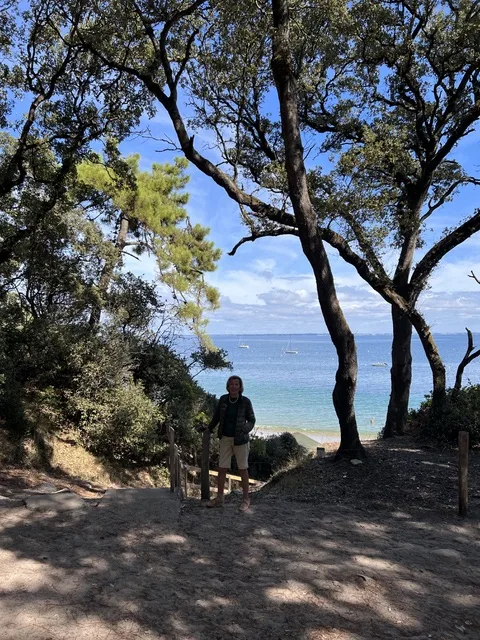
There is a second location at Port de Morin, on the west side of the island facing the open sea. Where miles of sandy beaches with dunes invite you to run and swim. There are only a few boats there. The location is used when there is strong east wind. Or if you want to experience the expanse of the open sea.
The club is incredibly active. In addition to the regular excursions, there are taster and training lessons for those interested, advanced training courses, tours to other places on the island with pique-nique, tours to the mainland. Then the beach will be cleaned. Long-distance patents and other diplomas are awarded. Hiking trips on the mainland are also carried out.
Everyone registers for the trips on the home page. Communication – such as sudden cancellations or changes to appointments – takes place via the Whatts app, in which all members are registered.
As elsewhere, one has the impression that the women have taken over the club, that is, they do the work and determine where it goes.
The current president is Anne Moreau.
Wolfgang Jacobi 6.10.26