

Anything a man can do can...
In the middle of the 19th century, English and Danish women discovered rowing for themselves, and at the end of this century, women began rowing in Germany as well. It was not until 1901, when the Women's rowing clubs in Friedrichshagen (FDRC), it is fitting for ‘bourgeois’ women to board a rowing boat. Also in 1901 the Berliner Herrenruderverein Forward as the first rowing club in Germany a women's division,1909 follows the Märkische rowing club. In 1911, teachers of the Oberlyceum founded a rowing club for schoolgirls in Kassel and on 19 May 1913 the Casseler Frauen-Ruder-Verein (CFRV). In 1919, the German Women's Rowing Association (DDRV) was founded because the German Rowing Association (DRV) refused to accept women's rowing clubs.

The Munich Rowing Club of 1880 was a pure men's club at the time of its foundation. Ladies were tolerated as guests, became members and were not allowed to row.


Tennis was considered a pastime at the time and in mixed you could get to know representatives of the opposite sex, they also spoke of the ‘engagement stench’. Of course, they adhered to the strict clothing etiquette, the skirt reached to the floor and a hat protected from the sun, while the gentlemen wore a cap like the croquet.


In 1890, ten years after its foundation, the MRC has 196 members and an Academic Rowing Department for students in Munich. The ladies are allowed to row from 1906, but as the chronicler Dr Grabe notes in his ‘One Hundred Years’: ‘Ladies’ rowing may only take place on weekdays and only on the ‘Caspar’ and ‘Albert’ boats ...’.


In general, women were able to row in clothes from 1911. From 1920, after long battles, ‘sports leg dresses’ (trousers) were finally allowed. However, a long, unbuttonable skirt was initially worn over the sports suit, which was only dropped in the boat.


Who the hell is Alice?
The fact that something is changing for women in the sports industry is due to the sports pioneer Alice Milliat. Born in Nantes on 5 May 1884 as the daughter of wealthy parents, she learns different languages, works as a French teacher in London and marries the merchant Joseph Milliat there as a 20-year-old. Her husband died after four years. Alice Milliat is now single and dedicated to the sport, as a swimmer and hockey player, participates in car races and competes in a rowing race over 80 kilometers. In her time in London, she had met the suffragettes and sportswomen who reported on training exercises in long trousers, hidden behind walls and bushes, and on condescending comments from journalists and husbands. However, in her Paris club »Fémina Sport«, in which Alice Milliat rows and whose president she becomes in 1915, the members can practice women's football, athletics, basketball, field hockey, rowing or cycling from 1912.

During the First World War (1914-1918), hundreds of thousands of women in factories took responsibility and won the right to vote in England, Germany and the USA. In 1919, Milliat wrote to the International Olympic Committee (IOC) calling for equal rights for women at the 1920 Games in Antwerp. When the IOC rejects, she founds the International Women's Sports Federation (FSFI) with comrades-in-arms from all social milieus. At the end of March 1921, they organized the first "Jeux Olympiques Féminins" in Monte Carlo. Around 100 athletes from France, Great Britain, Italy, Norway and Sweden compete in ten athletic disciplines, as well as in basketball, gymnastics, rhythmic gymnastics and pushball. The second World Games were held in Paris in August 1922 as the Women's Olympics with 20,000 spectators.
The female abdominal organs wither
Until 1934, a total of seven international sports competitions for women were held, first as the "Olympic Games for Women", later as the "Women's World Games", because the IOC prohibited Milliat from using the name "Olympic Games". Journalists spread the rumors that some female athletes fainted or cried "hysterically" during the competitions. According to the moral image of the time, women should only do sports for health reasons, and preferably in private. Doctors even declare women's sports to be dangerous. As late as 1931, the Leipzig gynecologist Hugo Sellheim argued: "Through too much sport according to the male pattern, the female body is directly masculinized, the female abdominal organs wither."
Apparently, the officials of the German Rowing Federation also share this view. Racing rowing cannot be established for women at first and until the 1950s all competitions were advertised as ‘young man’ with the male name. From 1919 onwards, ‘still rowing competitions’ were held specifically for women, the last of which were held in 1963 in the GDR and in 1969 in the Federal Republic of Germany. The ‘aesthetic’ rowing work, i.e. the rowing style, was not judged by the speed of the boats, as was the case with the race. On flowing waters, the distance was five hundred meters downstream, then after turning five hundred meters upstream. Similar to figure skating, the points were scored by male referees for bodywork and rudder guidance.
In 1911, the MRC founded a student and in 1924 a youth rowing department in 1880, but still does not allow female members. In 1927 Conrad Sill (1887 – 1960), racing rower and member of the Nuremberg ‘Duzendteich’, where he trains the eighth team, came to Munich with his family. Since there are no apartments there, the furniture is discontinued and the family lives temporarily for a year in a furnished apartment in Starnberg. The daughters Lotte, Trudl and Erni (born 6 February 1919) naturally go to the MRC 1880 after school, because Sill has immediately found a new sporting home here. Erni already steers her father's racing foursome as an eight-year-old, in 1930, when she started rowing herself at the age of eleven.
In 1887, the Munich rowing club had adopted a bathing regulation (bathing trousers obligatory!) and set up a men's bath. This ‘men’s pool’, clad in boards all around, still existed and the MRC did not have accommodation for the women and children of its Munich members. These sleep in rented Starnberger rooms, the men in the rowing club. In 1930, a small log cabin, the ‘Flohhütte’, was built on the west side of the property as a changing room for the few rowing ladies.


A new spirit and attitude towards women's sports
With the appointment of Adolf Hitler as Reich Chancellor by the Reich President Paul von Hindenburg on 30 January 1933 and the seizure of power by the National Socialists, the political landscape in Germany changes, also and especially in sport.
‘Across Germany, rowing was characterised by the events of the 1920s and 1930s and differed in many respects from today’s practice. For example, the educational concept was even more prominent in many clubs. “The aim was to give young people an educational perspective”. The older generations did not actively practice sports, but mainly financed the sport for the youth, while they used the club to maintain their contacts and networks. For this reason, there was generally a great deal of commitment to celebrations.
The year 1933 was followed by ‘a rigorous and consistent embedding of sport in the political-ideological concept of the new rulers’, which also did not omit rowing and fundamentally changed the association system of the entire Reich. Only associations that were loyal to the Nazis could continue to exist in the long term. In the summer of 1934, the association structure of German sports was completely dissolved and the German Reichsbund was designated as the successor organization for physical exercises. The new centre of power was the Reichssportamt in Berlin, while the Reichssportführer was the highest authority in German sport.’
‘The political-ideological adjustment process in the association becomes particularly clear when photographs before and after 1933 are compared. Uniforms replaced suits as formal clothing, military drills and order became more and more present in the club and line-up in rank and file according to the military model with Hitler salute dominated from now on boat baptisms and regattas’.
Philip Nentwig, Bremer Rudersport in the early years of the national socialism, "How did the Bremer Ruderverein of 1882 evolve into a Nazi-faithful sport in the course of the synchronisation from 1933 to 1936?", (award-winning) Contribution to the historical competition of the Bundes-Presidian 2020/21 "Movements". Sport makes society.
This description also applies to the MRC 1880.


When the Do X landed on Lake Starnberg on 29 April 1933 and the new Reich Chancellor boarded for a scenic flight, the rowers surrounded him in their boats.

In 1933, the DDRV joined the DRV and dissolved itself a short time later. With the founding of the German Federation of Physical Exercises on 30 January 1934, all German sports federations were brought into line.
The MRC Club News of September 1934 states under the heading ‘‘Healthy woman through physical exercises’. At the instigation of the Reichssportführer, an Reichswerbewoche will take place in October, which should arouse an understanding of the value of physical exercises for the German woman through appropriate propaganda of the clubs as well as press and radio in all layers of our people. It goes without saying that we will also take part in this promotional work.” A promotional evening on 13 April 1934 brought 69 new members (beginners) to the MRC, including sports students and sports students with an apprenticeship in sport. However, they receive support in sports training only if they join the young people or the H.J.. With the propagated ‘punitive sporting’ women’s ideal, competitions for women are now also possible and not rejected from the outset.

The club leader wrote to the newly won ‘members of the Frauen-Riege des Münchner Ruder-Club von 1880 e.V.’ in April 1934:

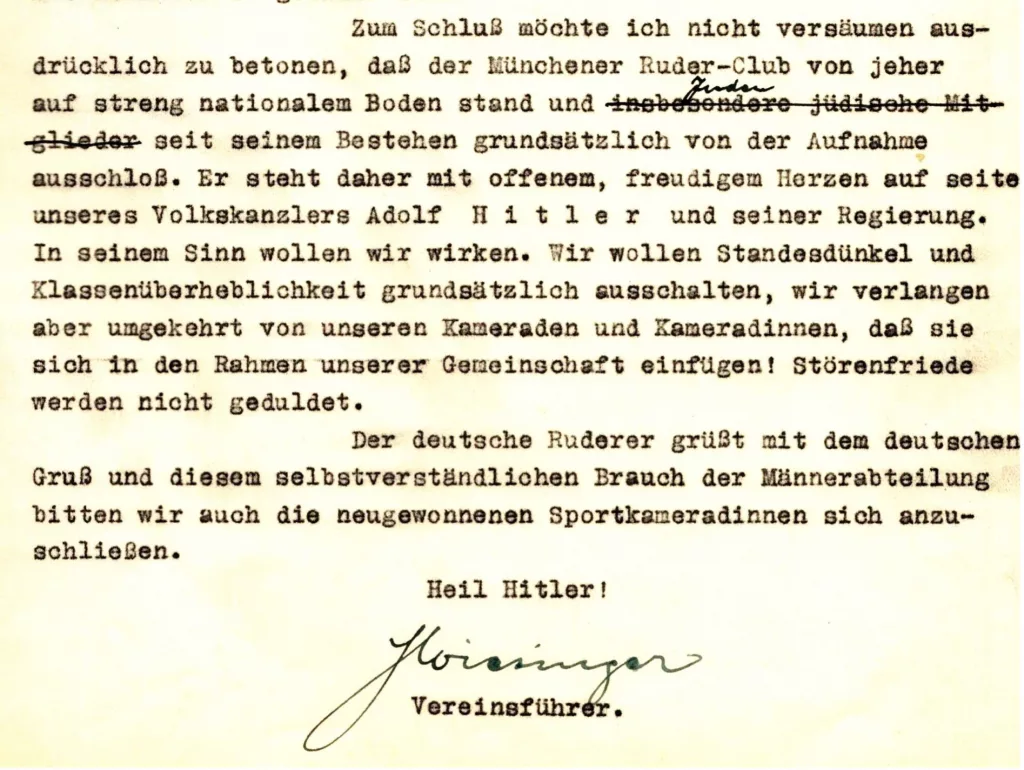

The club leader Hermann Wiesinger concludes his report for 1933/34 with the following words:

The Munich Rowing Club of 1880 e.V. (official address: Boathouse in Starnberg (left of the train station) – Boathouse on the Isar, Ifflandstraße) had built a makeshift boathouse on the Munich Museum Island (formerly called ‘Kalkinsel’) in 1884, then another boathouse below the Bogenhausen bridge in 1896. In the summer of 1934, a ladies' changing room and a shower room were added to this boathouse. The women may: Not only now, it should Even ‘as many ladies as possible participate in the rowing competition at the Internal Regatta on 16 September 1934 on Lake Starnberg’. Official rowing days for the women with lessons are recommended in Munich on Tuesday and Thursday from 5 p.m. and the women’s coach Conrad Sill recommends ‘that a team of two or four meet at a certain time’. A temporary women's section in the MRC with 32 members will initially be set up by October.

Almost a third of the 51 named participants of the Internal Regatta on 16 September 1934 belong to the SA. On the occasion of the solemn boat baptisms, official personalities are expected and the report in the Club News of November 1934 states: ‘... the youngest member of the youth section (took) the baptism of our first double-fourth in the name of our leader and people’s chancellor ‘Adolf Hitler’. The club leader H. Wiesinger writes in the same issue: “For the first time in the history of our MRC, ladies also started twice in double fours and stylised rowing”. The winners are the siblings Ott and Sill. Then the club leader officially addresses the women’s rowers and invites ‘all the ladies of our club, the previous women’s rowers and all those who have so far stood aside to Founding meeting a women’s section.’

The 16.11.1934 is the official founding day of the women's department
The ‘Women’s Division’ has 48 members in 1934 and 37 members one year later. Now the ladies get their own Starnberger ‘Damenhaus’, whose rooms are drawn among the mothers with children.

In 1883, the following was recorded in the list of members: a) Practitioners: Name (b) Supporters: Name and place of residence, if foreign (e.g. Bremen, London, etc.). 1895 is listed in the list of members: Name, status (e.g. merchant, hotelier, jeweller, etc.), place of residence, occurred on – date
Only in the case of the ladies who joined in 1935 stands behind the name of the religious affiliation.


Before 1933, the MRC 1880, like many other men's rowing clubs, was conservative-bourgeois and had moderately competitive ambitions.From 1933, the formerly elected board of directors was replaced by the ‘Führerbeirat’. The latter appoints the ‘association leader’, who has more powers but must be confirmed by the Reichssportführer. In November issue 34, the club leader H. Wiesinger strikes a sharp tone:


Those who are physically capable of racing but do not want to do so ('try to push') will be asked to leave the MRC 1880!


On 15 March 1935, the club received new articles of association at an extraordinary general meeting on the basis of a decree issued by the ‘Reichssportführer’ (Hans von Tschammer and Osten). Rowing is now a specialist office in the NS-Reichsbund for physical exercises, the youth department becomes a HJ and BDM department. Now it also applies to the ladies that they train and win (should).


On June 2, 1935, 75 rowers of the MRC took part in the march on the occasion of the Reichsruderwoche in Munich. First, they have to flee from a rainfall under the pillar hall.

After the rain, the men advance with a large banner at the top, followed by the uniformly dressed in white and blue MRC women. "Unfortunately, the training teams and the MRC-SA people were not able to participate," the club news said, "but our group was particularly noticeable because of the uniform clothing and the exact formation."

From the outset, the so-called ‘Foodstuffs“ Part of National Socialist education policy.
‘...it was the people's state of Adolf Hitler that proved right to the men who repeatedly demanded that, in addition to physical training, people's education should be carried out in full equality. Only then is the natural marriage between a powerful body and a radiant spirit accomplished and crowned.’ ... ‘One can clearly define the concept of a diet with one sentence: ‘The hearts and souls of our members of the association open up to the tremendous work of the Fuehrer!’ ... ‘The people are not some kind of state ... but a community of life, racially, i.e., blood-related people, whose common species is determined by the preponderance of a certain proportion of race and blood.’ ... ‘The Dietary system, in very close reference to the Reichsschulungsamt of the party, wants to carry and anchor the new and yet so ancient worldview of National Socialism into the associations of the Reichsbund. The purpose of the service is that the pride of being a German should be planted in the hearts of all who belong to us. Everyone should carry up their heads in front of the whole world and confess: I am a German! Diet is called upon to advance the association community into the vastness of the National Socialist worldview, to act and live as a German – the model is: Adolf Hitler.’
Ludwig Thannemann, ‘Dietwart’ of the club, in the MRC club news of December 1935
The women's section goes "from 65 members in 1935 to 55." Which members leave, whether they leave voluntarily or whether they have to leave, is not explained, the chronicler Dr. Grabe notes only: ‘The development of the ladies’ section and its rowing on the Isar suffers from the unfavourable weather conditions in 1935.’ In any case, the constant flooding hinders rowing to such an extent that the rowing operation in Munich is transferred exclusively to the Nymphenburg Canal and the boathouse on the Isar is later completely abandoned.

In 1936, the DRV had to dissolve itself.
At this point, before the development of women's rowing under the new political conditions is reported in the following in sober coolness, it should be emphasized: The MRC 1880 distances itself decisively from any brown disposition, whether in the past or in the present. The club and the author do not misunderstand and trivialize the crimes and criminals of this time, neither displace the persecutions nor the mass murders, even if these cannot be addressed in the present context.


As a summary of 1938, Dr. Jobst, of his character ‘Schschriftwart’ (= secretary), writes ‘and ‘Syndikus bei der Kapital der Bewegung’ (Syndicus at the capital of the movement): ‘The rowing of the men's department made little impression on me in the past year’ He notes a frightening lack of rowers of his age. The same observation should be made in the women's department. He recommends:a closer contact with the police, Wehrmacht, SS and SA!!“.
Despite active participation in a Hitler Youth regional regatta on 17 July 1938, a four-day solstice celebration of the party and an enlightenment evening on women's rowing on 12 May 1939, followed the next day by a practical demonstration followed by an invitation to coffee and cake, the women's section, whose cashier Erni Sill will be on 20 May 1939, weakens.
War and post-war period
With the German invasion of Poland on 1 September 1939, the war for ‘habitat in the East’ began. More and more men of the Munich rowing club are called to the Wehrmacht, at the end of the year already three members have fallen. The ‘unitary statutes’ issued by the N.S. Reichsbund for physical exercises were approved on 20 April 1940. The club leader is proposed by the members, he is appointed by the sports circle leader. On the occasion of the Führer’s birthday, the MRC dispenses 40 kg of brass, 5.5 kg of copper, 5 kg of zinc and 2.5 kg of tin for the ‘metal donation’.


To the club mates standing at the front, the ladies send field mail and for Christmas parcels with food and with the then common novellas in German writing. The letters of thanks of the convened men are printed in excerpts on the last page of the newspaper.


The women continue to row successfully at home. Erni Sill won the German Champion in 1941 in Bamberg not only in the Women's Senior One, but also in the ‘Stilrudern’, and the proud father gave her a particularly sleek racing skiff, the ‘Arfeil’.


In 1942, the ‘Bayern’ operated in the boathouse of the MRC, as the ‘Bayernheim’ had been confiscated by the German Wehrmacht. In April 1944, the ladies' house and the flea hut were also confiscated by the Wehrmacht, their department commander and all officers became members of the club. The ‘Ruderstiftung Kriegskameradschaft’ requires every German rower to make a donation in which ‘every rower expresses his or her holy anger at the outrage of his or her enemies’.
On 8 May 1945, the Second World War in Europe ended with the complete surrender of the German Wehrmacht. Twelve of the MRC's operatives have fallen, many in captivity. At the entrance to the clubhouse hangs an off-limit sign of the American occupiers and a sign ‘Reserved for 27the Evacuation Hospital’. A Hungarian refugee family lives in the ladies’ house, boat and clubhouse serve as a soldier and officer club with bar operation. Only thanks to an English-speaking air force officer named Lehmann, who served as an interpreter to the Americans in 1945, are the boats largely undamaged. Albert Mayer, club leader since 1943, tries in vain to grant the license to continue rowing.
In August 1946, the club received the ‘license’ for re-establishment. According to the order of the military government, ‘only unencumbered persons or ‘trailers’ may be admitted to the club. A readiness for re-entry must therefore be given with a corresponding declaration.’ The ladies’ house has been vacated and disinfected, but ‘some comrades who would have liked to have cooperated had to hold back officially because they had no ‘Persil certificate’ in their hands to date.’ (The so-called ‘Persil certificate’ served as an exculpatory certificate in the context of the denazification carried out by the Allies.)
Dissolution of the women's department and new beginning
1948 is rowed again on March 31st. For the teams of 7 ladies and 13 men committed to training, support from tea, sugar, potatoes and ‘nutrients’ is urgently requested. The club badge may be worn again. The women's section is rebuilt and the ladies return to regatta victories. On 13.4.1949 the offices of the women's department will be filled, but already on 31.3.1950 the dissolution of the women's department as an independent association will be decided by amendment of the statutes. In all offices of the club, a woman is elected as deputy. In 1951, Americans and refugees disappeared and now the ladies can once again live in the ‘women’s house’ and row with each other.

During the construction years of the ‘economic miracle’, the club becomes the place for holidays, sports and leisure activities for the whole family. Many members spend the entire holiday of their childhood here. In the 50s, an overnight stay on the weekend costs 80 pennies, during the week 50 pennies, so for the whole week 1.30 DM per day.
In 1960, the plan was made to increase the size of the ladies' house in order to win 10 rooms, but it was not implemented. In 1968, the first number of ‘Riemen und Skull’ appears. From 1969 the rowers mainly deal with the regatta track for the Summer Olympic Games in Munich, the rowing competitions take place in September 1972 on the regatta track in Feldmoching.
On April 19, 1980, the ceremony on the occasion of the club's 100th anniversary will be held at the Academy of Fine Arts in the Munich Residenz, and one day later the party will continue in the richly decorated Starnberger Bootshaus.


In 1984, the women celebrate 50 years of women's division. The club now has 300 members, half of whom actively row, about a third of whom are women. Erni Wörner still earns regatta victories at an advanced age on the Masters. At the same time, she is a trainer for ‘Youth trained for Olympia’ and looks after the older beginners after the end of her active career. Almost every day she rows in her skiff and is a sought-after partner for men and women for a ride in a two-person racing boat.
In 1976 the rent for a bed in the ladies' house costs 70 DM per year, in 1980 the sanitary facilities are to be improved. There are now more active people entering the club, but fewer and fewer women rent a bed in the more and more women's houses conquered by cobwebs, fewer and fewer families stay overnight or over the entire weekend. And so, in 1997, the first considerations for the construction of a new ladies' house were made. In 2000, a construction committee was set up, in 2003 the architect's plan and the estimates submitted by the board were approved, and in 2004 the building permit was granted.


Almost in time for the club's 125th anniversary, the new multi-purpose house will be finished. On the one hand, a simple longhouse houses the female members, on the other hand, a two-sided glazed pavilion is used for row-specific training, even in adverse weather conditions – for women and men alike.
Rediscovery of ‘still rowing’?
Erni Wörner, born in Sill, was not only a champion in racing and stylistic rowing, but in the almost 90 years of her membership in the MRC became his unforgettable soul and role model for all. When the ‘youngest’ honorary member dies on 13 January 2016, everyone has a very personal memory. Forever your words remain: ‘Laaaaang will be pre-rolling!’ Floating!’


Over the years, there are more and more women in the MRC, currently 257 female members are active in grassroots or competitive sports and are involved in the organization of the club, also at board level. For a long time, some remember, there was another, not always pleasant tone in the club. For Erni's credo that the faster a boat runs, the cleaner the rowing technique, she herself was the best proof. Perhaps it is not so absurd to reintroduce ‘still rows’. Not only as a competition program for women and men, but also in dealing with men and women on an equal footing with each other
U.M.

sources
Chronicle of Dr. Grabe, 100 Years of MRC 1880;
MRC archives of various albums, including ‘Bilder 1885-1910 aus Privatrhand N 7’;
Festschrift 125 Jahre Münchner Ruderclub von 1880 e.V.;
U. Mertz in Starnberger Stadtgeschichte 2011, vol. 8/1; Interview with Erni Wörner and R&S 2015, page 48/49;
Lörchner, J. (2021, 24 March). "The female abdominal organs wither": Women at the Olympics. DER SPIEGEL, Hamburg (external link);
File:Alice Milliat.jpg - Wikimedia Commons. (O.D.) (external link);

Blaschke, R. (2024, 10 January). The Women's Revolution. nd-aktuell.de (external link);
Wikipedia authors. (2010, 25 March). Stylish rowing (external link);
The Eternal Prototype: The historical history of the Do X – fliegermagazin. (2022, 25 May). Flying magazine (external link).